 Map Void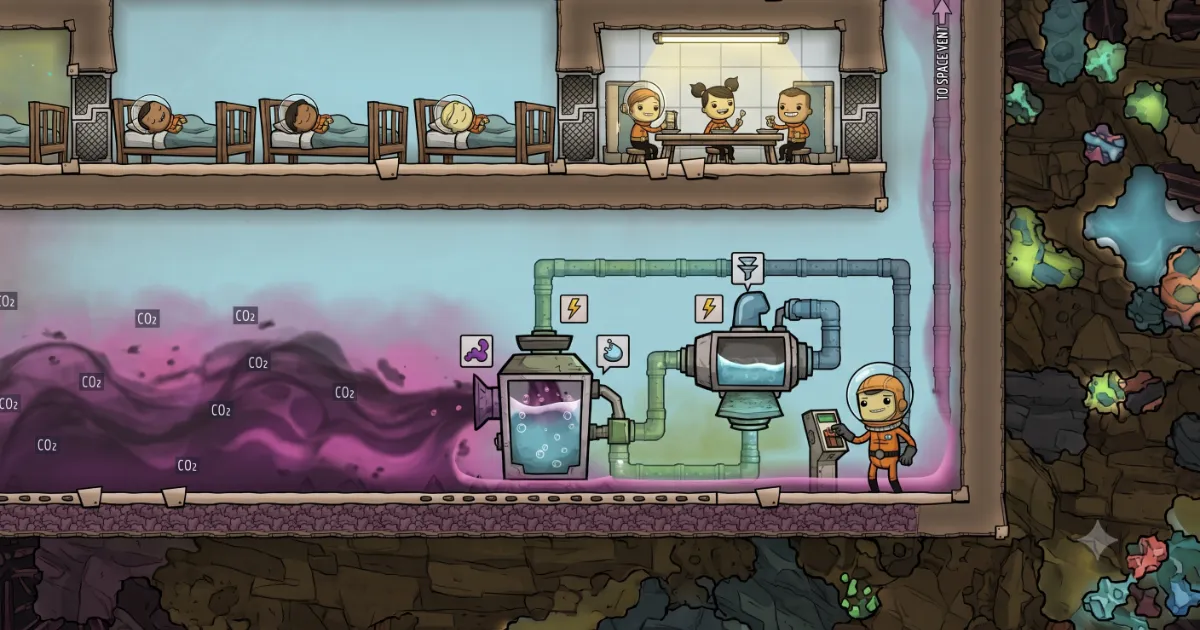
Oxygen Not Included: How to Get Rid of Carbon Dioxide
Is your Oxygen Not Included base filling with Carbon Dioxide? Learn the best community-tested strategies to remove CO2, from early-game pits to Carbon Skimmers.
jinci
Author
Table of Contents
Welcome, fellow colony managers! If you are playing Oxygen Not Included (ONI), you have probably noticed a dark, heavy gas creeping around the bottom of your base. Carbon Dioxide (CO2) is an unavoidable byproduct of keeping your Duplicants breathing and your coal generators running.
If left unchecked, CO2 will pool up, push out your breathable oxygen, and leave your Duplicants gasping for air. But don't panic! Managing CO2 is a fun puzzle, and there are many ways to handle it.
Based on the best strategies from top players on Reddit and the Klei forums, this guide will show you exactly how to get rid of Carbon Dioxide in Oxygen Not Included, using simple words and easy-to-follow steps. Let’s dive in!
Quick Answer: The Best Ways to Remove CO2
If you are in a rush and just need a quick summary for your base, here are the top methods for removing Carbon Dioxide at every stage of the game:
- Early Game: Dig a deep pit at the bottom of your base. CO2 is the heaviest gas, so it will naturally sink.
- Mid Game: Build a Carbon Skimmer connected to a Water Sieve in a closed plumbing loop. This is the most popular and efficient way to destroy CO2.
- Late Game: Feed the CO2 to Slicksters (critters that turn CO2 into crude oil) or pump it directly into the vacuum of space.
- Spaced Out! DLC: Save it and use it as free fuel for CO2 Rocket Engines!
Early Game
When you first start your colony, you don’t have the technology or power to actively destroy Carbon Dioxide. And that is perfectly okay! The best players on Reddit all agree on one simple early-game rule: just dig down.
1. Dig a CO2 Pit
Because gases in ONI have different weights, oxygen floats up, and CO2 sinks to the absolute bottom. By digging a large, empty area below your living quarters and using Airflow Tiles in your floors, you give the CO2 a place to settle safely away from your Duplicants' beds.
2. Turn the Pit into a Food Freezer
Experienced players on the forums highly recommend using this pit to your advantage! A pure Carbon Dioxide environment is considered "Sterile." If you put your Ration Boxes or unpowered Refrigerators at the bottom of this CO2 pit, your food will spoil much, much slower. It's a free, zero-power way to keep your meals fresh!
3. Grow Dusk Caps (Mushroom Farms)
Dusk Caps are a fantastic early-to-mid-game food source. While they do not actually eat or destroy the CO2, they require a Carbon Dioxide atmosphere to grow. Your dark, heavy CO2 pit is the perfect place to set up a mushroom farm.
What about Algae Terrariums? While the game suggests using them to clean air, veteran Reddit users warn against them. They consume a massive amount of water and algae while producing messy polluted water. It is usually best to skip them and save your resources!
Mid Game
Once you have a little bit of power and some basic plumbing researched, it is time to build the holy grail of CO2 management: The closed-loop Carbon Skimmer. This is by far the most recommended strategy across all ONI community forums.
A Carbon Skimmer takes in clean water and CO2, and spits out Polluted Water. A Water Sieve takes Polluted Water and sand, and spits out clean water. Do you see where this is going?
How to Build the Perfect Loop:
- Place a Carbon Skimmer at the very bottom of your base where the CO2 gathers.
- Place a Water Sieve nearby.
- Connect the liquid output of the Skimmer to the liquid input of the Sieve using pipes.
- Connect the liquid output of the Sieve back to the liquid input of the Skimmer.
- Use a Liquid Bridge to temporarily inject just a few packets of fresh water into the pipes to "prime" the system, then remove the bridge.
Why is this so amazing? Because it creates a closed system! The exact same water cycles back and forth forever. It destroys massive amounts of CO2, and the only resource it consumes is a little bit of power and some Sand (for the Sieve).
Late Game
Eventually, you might want to stop just destroying your Carbon Dioxide and start turning it into valuable resources. Here are the elite strategies for late-game CO2 management.
1. Ranching Slicksters
If you dig all the way down to the hot Oil Biome, you will find cute little critters called Slicksters. Slicksters breathe Carbon Dioxide and poop out Crude Oil (or Petroleum, if they are the Molten variant).
Players absolutely love Slicksters. You can set up a gas pump at the bottom of your base and pipe all your waste CO2 directly into a warm Slickster ranch. Not only does this solve your CO2 problem permanently, but it gives you free oil for plastic and power, plus delicious meat when the critters age out!
Pro Tip: Keep the room above 35°C, or they might turn into Longhair Slicksters, which breathe oxygen instead!
2. Venting to Space
If you don't want to deal with critters, the absolute easiest way to delete gas from the game is to throw it into the void. Once you dig up to the surface of the asteroid, you can build a gas pump at the bottom of your base and run a long ventilation pipe all the way up to space. The moment the CO2 touches the vacuum of space, it is gone forever.
3. Rocket Fuel (Spaced Out! DLC)
If you are playing the Spaced Out! expansion, CO2 suddenly becomes very valuable! The early-game rockets use Carbon Dioxide Engines. Instead of deleting your CO2, pump it into Gas Reservoirs and use it to launch your Duplicants to nearby planetoids.
What About Gas Compressors?
If you spend time reading advanced guides, you might see people talk about "Infinite Gas Storage" or "Door Compressors." This involves using a clever arrangement of liquid drops or automated mechanized doors to force thousands of kilograms of CO2 into a single tile.
While highly effective, many players consider this an exploit or a "cheese" strategy because it bends the game's physics. If you are a beginner, it is highly recommended to stick to Skimmers and Slicksters to learn the core mechanics first!
Summary
To wrap things up, managing Carbon Dioxide in Oxygen Not Included is all about matching your solution to your game stage. Let it sink in the early game, build a Skimmer loop in the mid-game, and feed it to Slicksters or Rockets in the late game. By following these community-tested strategies, your Duplicants will be breathing easy in no time.
Frequently Asked Questions
Yes, but only one specific plant. Oxyferns actively consume CO2 and produce breathable oxygen. However, they require dirt and a specific amount of water to survive. Dusk Caps (mushrooms) are often confused for CO2 removers; they need a CO2 atmosphere to grow, but they do not actually consume or delete the gas.
No. Carbon Dioxide has one of the lowest specific heat capacities of any gas in the game. This means it heats up and cools down extremely quickly, but it is terrible at transferring heat. Because of this, a room filled with CO2 will not effectively cool down heavy machinery like generators or batteries.
Yes! Carbon Dioxide has a relatively high freezing point for a gas. If you cool it down to -48.1°C (-54.6°F), it will freeze into solid Carbon Dioxide debris. While this takes a lot of power, some advanced players build "freezer traps" using Thermo Aquatuners to drop the gas into a solid state so Auto-Sweepers can simply carry it away.
Yes, it absolutely will. If you have multiple Coal Generators, Wood Burners, or just a large population of Duplicants producing CO2 without a removal system, the gas pressure will build. High pressure causes the "Popped Eardrums" stress debuff and will physically push all your breathable oxygen up and out of your main base.
Most veteran players highly recommend skipping them. While Algae Terrariums do absorb a small amount of CO2, they require constant Duplicant labor, consume massive amounts of clean water, and leave messy bottles of polluted water everywhere. It is almost always better to rush the research for a Carbon Skimmer instead.
This is one of the most common plumbing issues for new players! A closed Skimmer-Sieve loop needs empty space in the pipes for the liquids to move. If you pump too much fresh water into the loop to start it, the pipes get completely full and the system jams. To fix this, use the "Empty Pipe" tool (the plumbing icon) on just one or two pipe segments to give the water room to flow.