 Map Void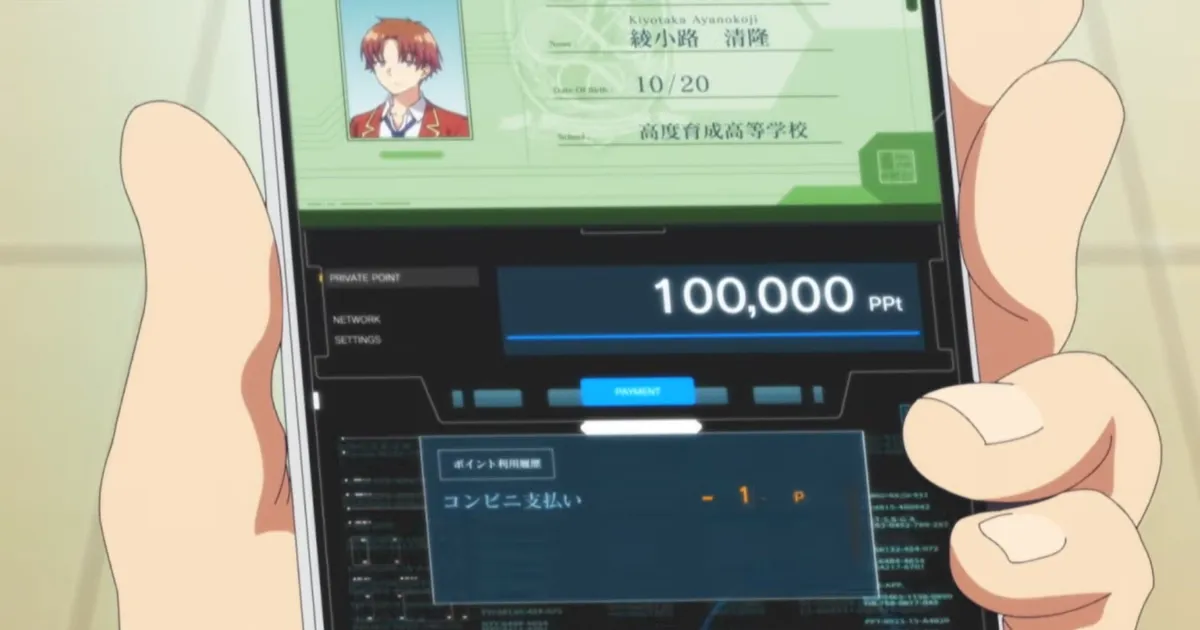
Classroom of the Elite: The ANHS Point System Explained
How does the point system work in Classroom of the Elite? Read our complete breakdown of Class Points, Private Points, Protection Points, and the buy-anything rule.
Juli
Author
Table of Contents
The Economy of Advanced Nurturing High School
In the world of Classroom of the Elite, the Tokyo Metropolitan Advanced Nurturing High School (ANHS) operates on a ruthless, hyper capitalist framework where money is quite literally power.
While most basic guides touch on the fact that students get an allowance, they often miss the nuances of the socioeconomic warfare happening beneath the surface. Everything on campus has a price, and the students who learn to manipulate this financial economy are the ones who ultimately control the school's hierarchy.
\[!NOTE\] This article breaks down the exact mechanics, math, loopholes, and community theories regarding the ANHS point system, including the Legendary 20 Million Point rule.
Class Points vs. Private Points
The biggest point of confusion for new fans is distinguishing between the two currencies. They are interconnected, but they serve completely different functions in the ANHS ecosystem.
Class Points (The Economic Engine)
Class Points (CP) determine a class's ranking (A through D) and dictate their monthly income. Every class starts the year with 1,000 Class Points.
- The Conversion Rate: 1 Class Point = 100 Private Points per student.
- Fluctuation: Class points are gained or lost collectively based on special exams and daily behaviour. In the first month, Class D lost all 1,000 points because of tardiness, sleeping in class, and phone usage, dropping their monthly income to zero.
- Meritocracy vs. Manipulation: The school doesn't reward raw academic merit; it rewards results. Sabotage, manipulation, and exploiting other classes in Special Exams are entirely valid ways to siphon Class Points from rivals.
Private Points (The Personal Currency)
Private Points (PP) are the actual spending currency loaded onto the students' ID cards.
- The Real World Value: 1 Private Point = 1 Yen.
- The Starting Allowance: Because every class started with 1,000 Class Points, every student received 100,000 Private Points in month one.
- Zero Point Survival: If a class hits zero Class Points, their Private Point income drops to zero. However, the school provides free, bare-minimum essentials (tasteless food, basic dorms) so students won't literally starve.
The "Buy Anything" Rule & The Hidden Menu
The school’s foundational rule is that "anything at this school can be bought with points." While students initially spend their points on video games, clothes, and cafe food, the true purpose of Private Points is manipulating the school system itself.
- Daily Necessities and Luxuries:The campus is built like a small city. Students can buy standard items: food, electronics, manga, cosmetics, and dorm appliances. The school even sells adult items like contraceptives, reinforcing that ANHS operates as a fully independent microcosm of adult society.
- The Hidden Menu: Bribes, Exams, and Rule Bending:This is where the system gets dark. If you have enough points, you can legally buy your way out of failure.
- Buying Test Scores: In Season 1, Ayanokōji successfully buys one single test point from Chabashira to save Sudō from expulsion . The cost? 100,000 Private Points.
- Purchasing Old Exams: Students can bribe upperclassmen to hand over previous years' test papers, legally acquiring the answers before an exam.
- Contractual Blackmail: Private Points can be transferred between students. This allows for extortion, hush money, and binding contracts. Ryūen famously exploits this by setting up a long term contract to siphon points from Class A to fund his own grand strategy.
The 20 Million Point Holy Grail
There are two legendary, astronomically expensive purchases a student can make to completely bypass the class hierarchy:
| Purchase | Cost | What it Does |
|---|---|---|
| Class Transfer Ticket | 20,000,000 PP | Allows a single student to permanently transfer to any class they want, typically Class A. |
| Expulsion Override | 20,000,000 PP + 300 CP | Cancels a finalized expulsion, saving the student from being kicked out of the school. |
\[!WARNING\] Amassing 20 million points is nearly impossible for a single student on a standard allowance. It requires massive, multi year extortion rings or school-wide gambling syndicates to accumulate this amount of capital.
The Ultimate Shield: Protection Points
Introduced during the incredibly brutal Class Poll exam in Year 1, Protection Points exist for one single purpose: they cancel out an expulsion.
If a student holds a Protection Point and triggers a penalty that would normally get them kicked out of ANHS, the school simply confiscates the Protection Point instead. The student gets to stay, essentially surviving a fatal blow.
Here is why they are so wildly overpowered—and why the school heavily restricts them:
- They are insanely rare: You don't get these on a monthly basis. They are only awarded during specific, high stakes Special Exams, usually to the student who contributed the most or survived a targeted voting system (Ayanokōji famously secures one to make himself virtually untouchable for a while).
- They are untransferable: Unlike Private Points, you cannot sell, trade, or gift a Protection Point to a friend. If you earn it, it’s bound to you.
- They don't stack indefinitely: You can generally only hold one at a time. If you win a second one while already holding one, the school doesn't let you bank it; instead, they might offer you a massive payout of Private Points (usually around 500,000) as compensation.
Having a Protection Point changes a student's entire psychological game. When you aren't terrified of expulsion, you can take massive, aggressive risks in Special Exams that other students wouldn't dare attempt.
Hard Limitations: What Can't Be Bought?
Despite the "buy anything" rule, discussions frequently highlight the hard limits the author established to prevent the story from breaking its own logic.
- Forced Actions: You cannot pay the school to force someone to do something against their will. However, you can use points to bribe or incentivize them to do it.
- Direct Expulsion: You cannot simply hand the school 10 million points and say, "Expel this student." You must use the points to create a scenario where the student fails a rule that results in expulsion.
Frequently Asked Questions
No, you can't just mug someone in the hallway and steal their points. The school uses a secure digital system tied to student ID cards (which function like smartphones). Point transfers require mutual agreement, which is why students use binding contracts, extortion, or gambling rather than physical theft.
Not really. The school creates a closed economy. Once you graduate, your Private Points become worthless in the real world. This is exactly why third-year students who are about to graduate are highly susceptible to point-buying schemes—they are desperate to dump their useless points in exchange for favors, or they just blow them all on luxury goods before leaving.
Yes. While it seems mathematically impossible for a normal student getting a standard allowance, it has been done. It usually involves setting up a class-wide or even inter-class syndicate, forcing multiple students to funnel their points to a single leader every month. Ryūen's entire early-series strategy hinges on legally extorting Class A to slowly build up this massive war chest.
To a very limited extent. You can't bribe a teacher to forge a test score out of thin air, but you can buy back a single point if a student fails a test by a fraction of a margin, provided the teacher agrees to the transaction. The school honors these transactions as long as the points are officially transferred.